5 Essential Steps to Master SHRM CP Situational Questions
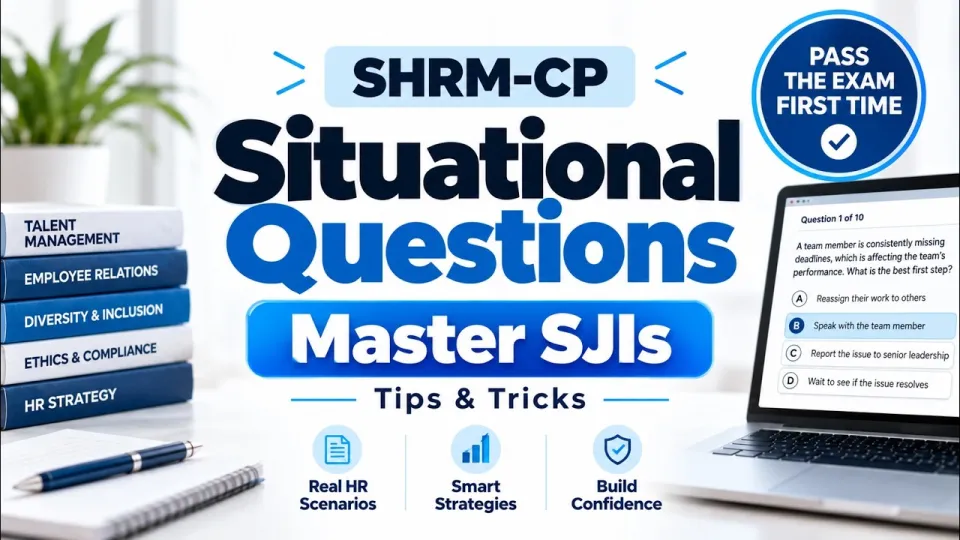
Video: SHRM CP Situational Questions (SJIs) | TIPS TO PICK THE RIGHT ANSWER
SHRM CP Situational Questions (SJI) challenge candidates to choose the best response among several plausible options in HR scenarios. To answer these effectively, it is crucial to understand how to differentiate between the next immediate step and the most effective resolution. Utilizing a structured approach can help you avoid common pitfalls and select the answer that aligns with SHRM’s standards and professional HR practices. For free practice questions and study guides, visit PrepSolution's SHRM-CP free practice site.
Understand the Question's Focus: First Step vs Most Effective Action
Many situational questions appear similar but differ in what they ask: the immediate next step or the best final resolution. Identifying this is critical:
- First Step questions require an action initiating the process without jumping ahead.
- Most Effective Action questions demand the best overall solution to the problem.
Careful reading of the question stem and keywords like "next step," "initial action," or "best approach" helps clarify this distinction. Choosing the wrong type leads to selecting answers that may seem reasonable but do not fit the scenario’s timing or scope.
Apply the Five Decision Checks
A reliable method for evaluating each answer option is to run it through five key decision checks:
- Facts: Does the option align with the scenario details and avoid assumptions?
- Policy and Law: Is the action consistent with company policies and legal requirements?
- Appropriate Escalation: Does it involve proper chain of command without unnecessary escalation?
- HR’s Role: Is the action appropriate for HR rather than another department or manager?
- People Involved: Are the relevant stakeholders or parties included or informed as needed?
This framework reduces bias from personal workplace experiences and ensures adherence to SHRM’s ethical and practical standards.
Recognize and Avoid Common Answer Traps
Situational judgment questions often include tempting but incorrect options designed as traps. Being aware of these traps improves accuracy:
- Premature Action: Taking steps before gathering facts or clarifying the situation.
- Passive Responses: Avoiding action or deferring responsibility when intervention is needed.
- Taking Over Manager’s Responsibilities: HR should support but not replace direct management actions.
- Unnecessary Escalation: Elevating issues too quickly without attempting resolution at the appropriate level.
- Legally Defective Options: Actions that could violate employment law or company policy.
Spotting these traps requires critical thinking and a clear understanding of HR’s role and boundaries.
Practice with Realistic Workplace Scenarios
Working through detailed scenarios helps solidify understanding. For example, consider a case where a supervisor wants to discipline an employee after a shouting match. The best HR response is not to immediately discipline or ignore the issue but to assess facts, consult policies, and ensure proper escalation.
Compare all available answer choices by applying the decision checks and identifying traps. This exercise builds skill in choosing the answer that fits the scenario’s context and SHRM’s professional standards.
Use Practical Elimination Techniques
When faced with multiple reasonable answers, eliminate options by:
- Testing each answer against the scenario’s exact wording and facts.
- Avoiding reliance on personal workplace habits, which may differ from SHRM guidelines.
- Considering the timing and sequence of actions required.
This practical approach narrows down choices and reveals the best fit.
Helpful Resources for SHRM CP Situational Judgment Questions
To hone your skills, utilize resources like PrepSolution’s free SHRM-CP practice questions and their Complete Pass System for comprehensive exam preparation. These tools include detailed explanations, answer strategies, and additional situational judgment practice.
PrepSolution SHRM-CP Free Practice Questions
Summary
Mastering SHRM CP Situational Questions requires understanding the difference between immediate and most effective actions, applying five decision checks, and recognizing common traps. Practicing with realistic scenarios and using elimination techniques sharpens your judgment skills. For ongoing practice and detailed guidance, the PrepSolution channel and their resources offer valuable support in your SHRM CP exam journey.
Key takeaways
- SHRM CP Situational Questions focus on realistic HR scenarios requiring judgment.
- Five decision checks guide the best answer: facts, policy, escalation, HR role, and involvement.
- Common traps include premature action, passive responses, and legal defects.
- Distinguish between 'first step' and 'most effective' action in questions.
- Practice with resources like PrepSolution's free SHRM-CP practice questions.
Source: SHRM CP Situational Questions (SJIs) | TIPS TO PICK THE RIGHT ANSWER · Markdown version
Questions & answers
What are SHRM CP Situational Judgment Questions?
They are scenario-based questions that assess your ability to choose the best HR-related action from multiple reasonable options.
How can I tell if a question asks for the first step or the most effective action?
Look for keywords like "next step" or "initial action" for first step questions, and words like "best approach" or "most effective" for final resolution questions.
What are common traps to avoid in SHRM CP situational questions?
Common traps include premature action, passive responses, taking over a manager’s role, unnecessary escalation, and legally problematic choices.
Where can I find free practice questions for SHRM CP situational judgment?
PrepSolution offers free SHRM-CP practice questions and study guides at their website: https://prepsolution.com/free-practice/shrm-cp?utm_source=youtube&utm_medium=video&utm_campaign=shrmcp_longform&utm_content=cp_long_v09